

The rate you were quoted is not a rate. It is two numbers added together and printed as one, and only one of them was ever negotiable. That is the whole reason Saberpay exists.
Saberpay is payment processing built for tax and accounting offices, and it came out of the Latino Tax Pro network, where we spent years watching preparers quietly overpay to accept a card. Every processor pays the card networks the same wholesale interchange. The only part any of us sets is the markup on top. So we publish ours: interchange + 0.80% + $0.20, the same in April as in August, whether you run $5,000 a month or $500,000.
This piece is the introduction. What we are, why we built it for your season specifically, what we charge, how to check our math against your own statement, and the kind of office we will tell to stay where it is.
Key Takeaways
- A blended rate is wholesale interchange plus a processor markup, printed as one number. A Federal Reserve Bank of Kansas City study puts it plainly: small merchants are typically sold flat-rate pricing, which obscures what interchange cost on each sale, while large merchants get interchange-plus, which does not (Hayashi, Federal Reserve Bank of Kansas City, March 2025).
- Square's published US price is 2.6% + $0.15 when a card is tapped or dipped and 3.5% + $0.15 when it is keyed in by hand, which is how a lot of tax offices take payment over the phone (Square, retrieved 2026-10-05).
- Saberpay charges interchange plus a published 0.80% + $0.20, plus $25 a month for the account, with no volume tiers.
- Your earning window is tight: 80.5% of the professionally prepared e-filed returns the IRS received through May 1, 2026 arrived in the nine weeks between February 13 and April 17 (calculated from IRS Filing Season Statistics).
- You can check all of this yourself. Add every fee on your last statement, divide by that month's card volume, and compare the result to any quote, including ours.
What Saberpay actually is
Saberpay is merchant services for tax and accounting offices: card processing, a point of sale that starts at $0, and bilingual support that answers 24/7/365. It is a sub-account program powered by SoftPoint LLC, running on Fiserv rails, and it sits inside Saber Tech Group alongside the software that same group already builds. That is why the point of sale and the processing come from one place instead of two vendors pointing at each other when something breaks.
Three things are worth stating plainly before anything else.
The pricing is interchange-plus, and the plus is published. You pay the real interchange your cards actually cost, plus 0.80% + $0.20 per transaction on Visa, Mastercard, and Discover (0.90% on American Express, 0.95% on other cards), plus $25 a month to keep the account open.
The hardware is not a hostage. Lite POS and above integrate with the point of sale and the software you already run, so there is no rip and replace. If you would rather carry nothing at all, SoftPoint on an iPhone or Android phone turns the phone itself into the terminal.
Support is a person. In English or Spanish, around the clock, trained on how tax and accounting businesses work rather than on a generic script. That is not a garnish. Roughly 40 million people in the United States speak Spanish at home (Pew Research Center, October 2025), and plenty of them are sitting across the desk from you in February.
Why we built it
We did not arrive at tax offices from the outside. Saberpay came out of more than a decade of training and supporting Spanish-speaking tax professionals through Latino Tax Pro, and the pattern that produced this company showed up in the same conversation over and over.
Ask an owner what they pay to accept a card and you get a number half remembered from a sales call. Ask what that number is made of and the conversation stops. That is not inattention. The statement is built so the answer is hard to find: a blended rate, a handful of line items with names that explain nothing, and an effective rate you have to compute yourself from the deposits.
This is not a feeling. Fumiko Hayashi, an economist at the Federal Reserve Bank of Kansas City, describes the split directly. Small merchants are typically sold flat-rate pricing, which obscures what interchange actually cost on each sale, while large merchants are on interchange-plus, which shows the individual fees and gives them something to negotiate with (Federal Reserve Bank of Kansas City, March 27, 2025). The same paper found that after regulation capped debit interchange for the largest issuers, the rates charged to small merchants did not broadly fall. Across thirteen networks, nine cut fees in at least one category, five raised them in others, and the increases substantially exceeded the cuts.
So the goal we set was narrow and testable. Make the markup the headline, keep it the same at every volume, and be reachable when the terminal stops working on April 12th. Everything else about this company follows from those three.
The part of the bill you can actually negotiate
A card payment costs you three things, and only one of them is a choice.
Interchange goes to the bank that issued your customer's card. Visa and Mastercard both publish the full schedules, and the Visa one (effective April 2026) is worth opening once in your life. Assessments go to the networks themselves. Neither moves because you negotiated well, and no processor can sell you a discount on them. The markup is the processor's price for doing the work, and it is the only line where shopping around changes your bill.
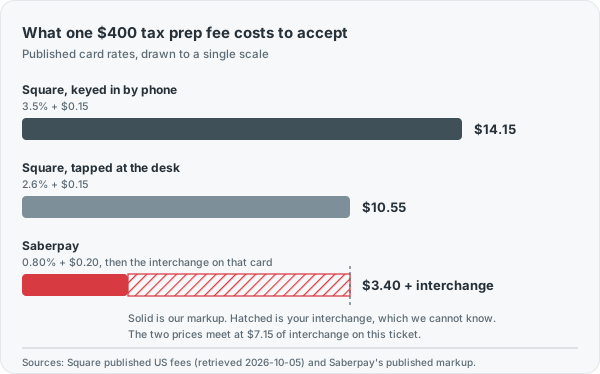
The third bar is on the same scale as the other two. The hatched part is the piece we cannot fill in for you, because it depends on your cards. Under $7.15 of interchange on this ticket you pay less here, over it you pay more.
This is why a flat rate is so comfortable to sell and so expensive to buy. One number is easy to say in a sales call. It is also a number that cannot be audited, because the markup inside it is invisible by construction, and it does not fall when your card mix is cheap. A debit card that costs the processor a fraction of a credit card still bills you the same blended percentage.
It is worth knowing what the other end of the market pays. Across every US merchant in 2024, the all-in cost of accepting cards averaged 1.57% of volume, on $187.20 billion of total fees (The Nilson Report, March 2025). That average is weighted by volume, so it is dominated by the largest merchants in the country on heavily negotiated agreements. It is not what your office pays. It is what scale and transparency buy, and the distance between 1.57% and the 3.5% a keyed-in payment costs on a flat rate is the entire subject of this article.
How to read your own statement in two minutes
You do not need us for this part. Take your most recent merchant statement and add up every line that is a fee: the discount rate, the per-item charges, the monthly account or statement fee, the PCI charge, and anything described as a service, network, or regulatory fee. Divide that total by the card volume you processed that month.
The result is your effective rate. It is the only number worth comparing against anyone's quote, including ours, and it is usually higher than the rate people believe they are on. If you do nothing else after reading this, do that.
Why this costs a tax office more than it costs a restaurant
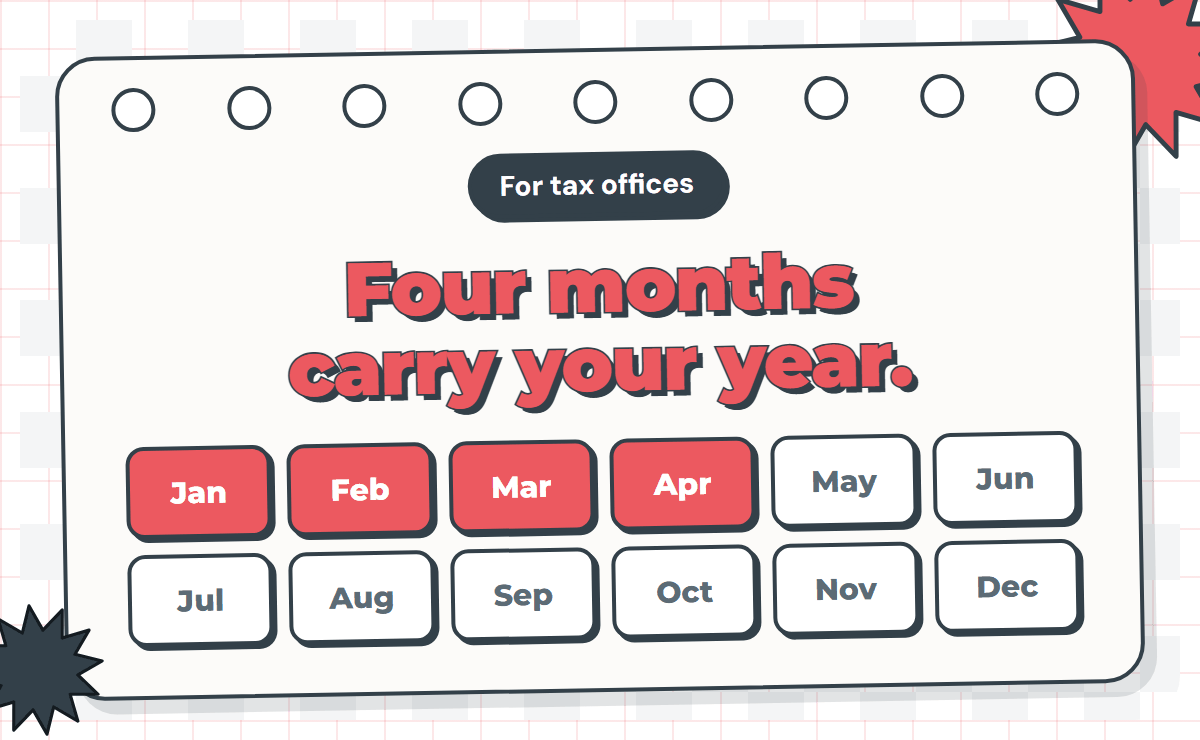
A tax practice does not run a steady year, and the data is blunter than the cliché. Of the professionally prepared e-filed returns the IRS received through May 1, 2026, 80.5% arrived in the nine weeks between February 13 and April 17, and 51.9% arrived in the five weeks between March 13 and April 17. By April 17 the season was 97.5% done. Those percentages are calculated from the IRS's own weekly counts (IRS Filing Season Statistics, 2026 filing season), and the May 1 cumulative excludes extension filers running through October.
Three things follow from that shape, and they all point the same direction.
A percentage compounds hardest in season. The gap between two rates looks trivial on a quiet August. Multiply it across a season's volume and it becomes a real number on a day when your cash flow is already stretched by payroll and marketing.
Keyed-in payments cost the most, and tax offices make a lot of them. A client calls to pay for last year's amendment and reads a card number over the phone. At Square's published US pricing that payment is billed at 3.5% + $0.15, against 2.6% + $0.15 for the same card tapped at the desk (Square, retrieved 2026-10-05). The card did not change. The entry method did.
Downtime has a date attached. Every business hates an outage. Yours has a deadline behind it. If the reader stops working on April 12th, you cannot spend forty minutes on hold with a processor that has never heard the words refund transfer.
Here is the arithmetic on a single ordinary return. A $400 fee tapped at the desk costs $10.55 at Square's published card-present price. The same $400 keyed in over the phone costs $14.15. Saberpay's markup on that $400 is $3.20 plus $0.20, so $3.40.
Run 600 returns at $400 and those scale to $6,330 of Square fees at the card-present rate, against $2,040 of Saberpay markup plus $300 a year for the account. Those two figures are not the same kind of number and we are not going to pretend they are. Square's includes the interchange on every one of those cards, and ours does not. What the comparison gives you is a test you can run yourself. The $3,990 between them is the room your interchange has to fit inside, and on $240,000 of volume that works out to an effective interchange of about 1.66%. Come in under that and you pay less here. Come in over it and you pay more, and we would rather you find that out from your own statement than from us six months in.
That is also why we will not publish a savings figure with your name on it. We do not know your card mix, so we do not know your interchange, and any number we invented would be marketing. Our own calculator is built to report a loss when there is one.
The alternative everyone else is selling, and why we think it is worse
The industry's current answer to rising card costs is to hand them to the customer. In J.D. Power's 2026 US Merchant Services Satisfaction Study, which surveyed 4,407 small businesses, 35% now add a surcharge to credit card payments, up from 34% the year before. Nearly a third, 32%, said customers occasionally or frequently abandon a purchase when the surcharge appears (J.D. Power, January 2026).
For a tax office that is a worse trade than it looks, because your clients are already fee-sensitive in a way most retail customers are not. The Treasury Inspector General for Tax Administration found that 21.9 million of the 138 million e-filed returns for tax year 2023 carried a refund-related product, and that taxpayers paid more than $842 million in fees to receive their refunds that way (TIGTA, November 2024). Those products exist because a large share of your clients cannot write a check in February.
We are not here to tell you refund transfers are wrong. For plenty of practices they are the difference between a client who files and a client who does not. The point is narrower. If a meaningful share of the people in your waiting room are counting dollars, adding 3% at the counter is not a neutral act. Lowering what the payment costs you in the first place is the version of that move that costs the client nothing.
Taking cards at all is no longer optional either. In the Federal Reserve's most recent Diary of Consumer Payment Choice, debit and credit were the preferred in-person payment method for 40% and 38% of consumers against 16% for cash, and cash has settled into third place at about one payment in seven (Federal Reserve Financial Services, May 2026, reporting 2025 data). The same study notes that lower-income households still use cash more than anyone else, which is worth remembering before any office decides to stop taking it.
Four rules we do not bend
The mission is easier to judge as rules than as adjectives, so here are ours.
Show the whole number. Interchange and our markup appear as separate lines because they are separate things. A single blended rate is a decision to keep you from checking.
One markup, at any size. The same markup at $5,000 a month and at $500,000. No teaser tier you age out of, and no quiet annual increase.
Answer in your language. Bilingual support, 24/7/365, from people trained on how these businesses actually run. Not a phone tree with a Spanish option.
Say no when it is no. If your current rate is already lean, we tell you. Our own calculator reports a loss when there is one, which is the only version of this pitch worth making.
What it costs
Processing price is the same on every plan: interchange + 0.80% + $0.20, plus $25 a month for the merchant account. What changes between plans is the software around it.
| Plan | Price | Best for | What it adds |
|---|---|---|---|
| Free | $0/mo | Up to 2 terminals | Standalone payments, Tap to Phone, transaction reporting, 24/7/365 support |
| Lite POS | $30/mo per terminal | Up to 15 terminals | Integrations to an external POS and processor, employee management, an online menu page |
| Full POS | $50/mo per terminal | Up to 15 terminals | Multi-location dashboard, advanced reporting, timekeeping, review management, plus the hospitality tools (table management, QR order and pay) |
| Enterprise | Custom | Multi-location operations | Custom SLAs, advanced analytics, omnichannel, gift cards and loyalty, dedicated support |
A one-office practice taking payments at a front desk is the Free plan: two terminals, no software fee, and the same markup as everyone else. Funds settle to your bank the next business day when you batch by 10pm local time.
Who Saberpay is not for
We would rather say this here than waste your week.
If you are already on a genuine interchange-plus agreement with a markup below ours, you are in good shape, and switching to us is probably a lateral move or worse. High-volume merchants on providers like Helcim, Stax, or Dharma can pay a smaller markup than 0.80%, usually in exchange for higher monthly fees or volume minimums. We publish a side-by-side of those processors and their markups for exactly this reason. The honest comparison is your real effective rate against ours, not a sales claim against a sales claim.
If you process a few thousand dollars a year, the $25 monthly account fee is a real part of your math and may wash out the savings. Run it before you move.
And if what you need is a processor who will tell you what you want to hear, we are going to disappoint you in the first call rather than the sixth month.
Where to start
Send us a recent statement. The savings analyzer reads your actual effective rate and card mix from it and shows what you pay now against what you would pay here, including the cases where the answer is that you should stay put. If you would rather estimate first, the calculator on that same comparison page takes last season's volume and needs no signup.
Most offices are live within days, mid-season included, with no downtime at the counter and no requirement to replace the software your front desk already knows.
Talk to a person at 1-800-784-0277, in English or Spanish, or email sales@saberpay.io.
Frequently asked questions
A longer set of answers lives on the Saberpay FAQ.
How does interchange-plus pricing work?
Every processor pays the card networks the same wholesale interchange, and that part is a fixed floor nobody controls. On top of it we add one published markup: 0.80% + $0.20 per transaction for Visa, Mastercard, and Discover, 0.90% for American Express, and 0.95% for other cards, plus a $25 monthly account fee. Flat-rate processors bury a larger markup inside one number, so you only ever see the sum.
Can I switch in the middle of tax season?
Yes. Setup is fast and there is no rip and replace, so most offices are running on Saberpay within days with no downtime at the counter. Funds settle to your bank the next business day.
Does my rate change because my volume is seasonal?
The markup does not. Interchange itself varies a little by card type, so your total moves with your card mix, but the markup is the same whether you run 30 returns in July or 600 in April. No volume tiers and no busy-season repricing.
Do I have to replace my hardware or my software?
No. Lite POS and above integrate with your existing point of sale and processor, and you can keep what you already run, from QuickBooks to a CRM. You can also take payments with no hardware at all by running SoftPoint on an iPhone or Android phone.
Is the support really bilingual?
Yes. Call in English or Spanish and reach a person who understands tax and accounting businesses rather than a general-purpose call center, 24/7/365.
Where this goes next
Saberpay is a narrow bet: that the reason tax offices overpay to accept cards is not carelessness but a statement built to be unreadable, and that publishing one honest markup is enough to fix it. Everything we build from here gets judged against that, starting with the reporting that shows you what the season actually cost.
The ground may shift a little underneath all of us. In June 2026 a federal judge granted preliminary approval to a roughly $38 billion settlement with Visa and Mastercard that would cut average US credit interchange by about 10 basis points for five years and cap standard consumer card rates at 1.25% for eight (PYMNTS, June 2026). It is preliminary, and interchange is only the floor. If it holds, the floor drops for everyone, and the markup sitting on top of it matters more rather than less.
If you want the number for your own office rather than ours, the fastest path is a recent statement and about two minutes.